

Mostrando postagens com marcador Cooking Class. Mostrar todas as postagens
Mostrando postagens com marcador Cooking Class. Mostrar todas as postagens
segunda-feira, 19 de julho de 2010
segunda-feira, 3 de maio de 2010
terça-feira, 17 de novembro de 2009

quinta-feira, 22 de outubro de 2009

quarta-feira, 7 de outubro de 2009
Cooking Class

Segue a receita e um pouquinho da história do Chicken Pot Pie, o último prato preparado na Cooking Class!!
A pot pie is a type of baked savory pie with a bottom and top completely encased by flaky crusts and baked inside a pie tin to support its shape.
This is in contrast to the Australian meat pie and many British regional variants on pie recipes, which may have a top of flaky pastry, but whose body is made from heavier, more mechanically stable shortcrust, hot water crust or similar pastry.
The pot pie is a variation of the pasty.
An American pot pie typically has a filling of meat (particularly beef, chicken or turkey), gravy, and mixed vegetables (potatoes, carrots, green beans and peas) Frozen pot pies are often available in individual serving size.
Variations
Some American pie rotations have no bottom crust and are more similar to a baked casserole (or chicken and dumplings) than to a traditional meat pie. Since the remaining top crust is not required to offer any structural support, it can be made by closely spacing small dollops of drop biscuit dough onto the stew-like filling before baking.
In the Pennsylvania Dutch region, there is a dish called "bott boi" by Deitsh-speaking natives and is mispronounced "pot pie" by English speakers in the area. This dish is sometimes referred to as "slippery noodle pot pie" to distinguish it from the true pie form of pot pie. Bott Boi is a stew, usually made of a combination of chicken, ham, beef, or wild game with square-cut egg noodles, potatoes, and a stock of onion, optional celery and/or carrots, and parsley. Bouillon is sometimes used to enhance the flavor.The egg noodles are often made from scratch from flour, eggs, salt (optional) and water. Some recipes use leavening agents such as baking powder.
1/3 cup oil (olive or vegetable)
1 tsp minced garlic
¼ tsp onion salt
¼ tsp black pepper
•
1 cup flour
2 tsp baking powder
½ tsp ground sage
2 tbsp butter (separate)
1/8 teaspoon salt
1/3 cup milk
•
1/2 cup chopped onion
1 cup sliced carrots
1 cup green peas
1 can of heavy cream
1/8 tsp black pepper
1/8 tsp salt
garlic
1 cup chicken broth
Preheat oven to
Chicken:
In a skillet, place oil, minced garlic, onion salt, black pepper, and
Cook on medium to high heat until cooked through. Drain and leave in strainer for future use.
Crust:
In a large bowl, combine flour, baking powder, ground sage, salt, butter, and milk. Form into a ball, roll out.
Using skillet from the chicken, add carrots, celery, and onion. Pour in enough broth to cover the vegetables. Set left over broth aside for future use.
Bring to a boil, reduce heat and simmer for 10-15 minutes.
In the same bowl used to prepare the crust, combine chicken, carrots, onion, celery, frozen peas, condensed soup, celery seed, pepper, salt, garlic powder. Add left over chicken broth until the desired consistency is reached.
Lightly grease a 9”x9“dish. Place mixture in bottom. Place crust on top and brush with egg whites or butter.
Bake in preheated oven for 30 to 35 minutes, or until crust is golden brown and filling is bubbly.
Cool for 10 minutes before serving.
Marcadores:
Cooking Class

terça-feira, 8 de setembro de 2009

quinta-feira, 20 de agosto de 2009
BAKED POTATO


Essas fotos me deram água na boca!!
Segue a Receita:
Ingredients
- 1 large russet potato (If it looks like Mr. Potato Head(r), you've got the right one.)
- Canola oil to coat
- salt
Directions
Heat oven to 350 degrees. Wash potato (or potatoes) thoroughly with a stiff brush and cold running water. Dry, then using a standard fork poke 8 to 12 deep holes all over the spud so that moisture can escape during cooking. Place in a bowl and coat lightly with oil. Sprinkle with salt and place potato in the oven. Place a baking sheet on the lower rack to catch any drippings.
Bake 1 hour or until skin feels crisp but flesh beneath feels soft. Serve by creating a dotted line from end to end with your fork, then crack the spud open by squeezing the ends towards one another. It will pop right open. But watch out, there will be some steam.
NOTE: If you're cooking more than 4 potatoes, you'll need to extend the cooking time by up to 15 minutes.
TOPPINGS
· Chives: 1 pkg of green chives. Wash them very well and chop it.
· Bacon:
· Grated cheese: grate 250g of cheese of your choice.
· “Requeijão”: use one cup of our Brazilian favorite cheese.
Marcadores:
Cooking Class
quinta-feira, 30 de julho de 2009
Baked Potato

NEXT COOKING CLASS...
BAKED POTATO
Baked Potato History
BAKED POTATO
Baked Potato History
A baked potato, also known as a jacket potato when given additional fillings such as cheese, ham, or chicken, is the edible result of baking a potato. When well cooked, a baked potato has a fluffy interior, but a crispy skin.
Potatoes can be baked in a convection oven, a microwave oven, on a grill, or on/in an open fire. Some restaurants use special ovens designed specifically to cook large numbers of potatoes, then keep them warm and ready for service.
Prior to cooking, the potato needs to be cleaned, with eyes and surface blemishes removed, and possibly basted with oil or butter and/or salt. Pricking the potato with a fork or knife allows steam to escape during the cooking process. Potatoes cooked in a microwave without pricking the skin might explode due to built up internal pressure from unvented steam. It takes between one and two hours to bake a potato in a conventional oven. Microwaving takes from six minutes but does not generally produce a crisp skin.
Some varieties of potato such as Russet and King Edward potato are more suitable for baking than others, due to both their size and consistency.
Wrapping the potato in aluminium foil before cooking in a standard oven will help to retain moisture, while leaving it unwrapped will create a crispy skin. When cooking over an open fire or in the coals of a barbecue it may require wrapping in foil to prevent burning of the skin. A potato buried directly in coals of a fire cooks very nicely, with a mostly burned and inedible skin. A baked potato is fully cooked when its internal temperature reaches 99 °C (210 °F).
Once a potato has been baked, some people remove the skin and eat only the softer and moister interior, while others enjoy the taste and texture of the crispy skin. From a nutrition standpoint, a large percentage of the vitamins, minerals, and trace elements in a potato are found within or immediately below the skin. Potatoes baked in their skins may lose between 20 to 40% of their Vitamin C content because heating in air is slow and vitamin inactivation can continue for a long time. Small potatoes bake more quickly than large ones and therefore retain more of their Vitamin C.[1] Despite the popular misconception that potatoes are fattening, baked potatoes can be used as part of a healthy diet
Potatoes can be baked in a convection oven, a microwave oven, on a grill, or on/in an open fire. Some restaurants use special ovens designed specifically to cook large numbers of potatoes, then keep them warm and ready for service.
Prior to cooking, the potato needs to be cleaned, with eyes and surface blemishes removed, and possibly basted with oil or butter and/or salt. Pricking the potato with a fork or knife allows steam to escape during the cooking process. Potatoes cooked in a microwave without pricking the skin might explode due to built up internal pressure from unvented steam. It takes between one and two hours to bake a potato in a conventional oven. Microwaving takes from six minutes but does not generally produce a crisp skin.
Some varieties of potato such as Russet and King Edward potato are more suitable for baking than others, due to both their size and consistency.
Wrapping the potato in aluminium foil before cooking in a standard oven will help to retain moisture, while leaving it unwrapped will create a crispy skin. When cooking over an open fire or in the coals of a barbecue it may require wrapping in foil to prevent burning of the skin. A potato buried directly in coals of a fire cooks very nicely, with a mostly burned and inedible skin. A baked potato is fully cooked when its internal temperature reaches 99 °C (210 °F).
Once a potato has been baked, some people remove the skin and eat only the softer and moister interior, while others enjoy the taste and texture of the crispy skin. From a nutrition standpoint, a large percentage of the vitamins, minerals, and trace elements in a potato are found within or immediately below the skin. Potatoes baked in their skins may lose between 20 to 40% of their Vitamin C content because heating in air is slow and vitamin inactivation can continue for a long time. Small potatoes bake more quickly than large ones and therefore retain more of their Vitamin C.[1] Despite the popular misconception that potatoes are fattening, baked potatoes can be used as part of a healthy diet
Marcadores:
Cooking Class
terça-feira, 7 de julho de 2009
Mac 'n' Cheese
Conforme o prometido, segue a sensacional receita do Cooking Class do mês de Julho.
Que aliás, estava uma delícia!
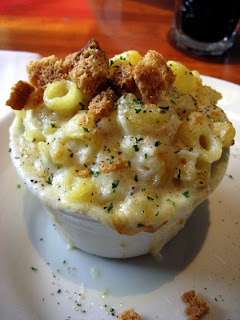
Cooking Class – Teacher Roberta
Family-Favorite Macaroni and Cheese
Prep Time: 25 min
Total Time: 50 min
Makes: 6 servings (about 3/4 cup each)
2 cups uncooked macaroni
1/4 cup butter or margarine
1/4 cup all-purpose flour
1/2 teaspoon salt
1/ 2 teaspoon paprika
1/4 teaspoon pepper
2 cups milk
2 cups shredded or cubed Cheddar cheese
2 cups shredded mozarella cheese
1. Heat oven to 350ºF.
2. Cook macaroni as directed on package.
3. While macaroni is cooking, melt butter in 3-quart saucepan over low heat. Stir in flour, salt, pepperand paprika. Cook over medium low heat, stirring constantly, until mixture is smooth and bubbly; remove from heat. Stir in milk. Heat to boiling, stirring constanly. Boil and stir 1 minute. Stir in cheese. Cook, stirring occasionally, until cheese is melted.
4. Drain macaroni. Gently stir macaroni into cheese sauce. Pour into ungreased 2-quart casserole. Bake uncovered 20 to 25 minutes or until bubbly.
A little history and a variety of recipes for Macaroni and Cheese
It probably wouldn't be on the menu for your mother-in-law's first dinner visit, and it isn't exactly gourmet fare, but macaroni and cheese is one of the most popular--if not the most popular--American comfort foods. Nearly every soul food cookbook and many Southern cookbooks have recipes for the American favorite, with few differences from one to the next.
Some believe the dish was created by founding father Thomas Jefferson, known for his great interest in food, and in a 1996 "Restaurants & Institutions" article, Barbara Bell Matuszewski wrote that Jefferson served the dish in the White House in 1802. However, noted food historian Karen Hess claims Jefferson did not invent the dish, though he did return from a trip to Paris with a macaroni mold. In the
According to John Mariani, author of "The Dictionary of American Food and Drink," macaroni and cheese was first made in the nineteenth century, but it took on a even greater popularity when Kraft Foods introduced the Kraft Dinner (macaroni and cheese) in 1937. According to a company spokesperson, Kraft now sells more than one million boxes of the dinners every day! The Kraft dinners are so popular, in fact, that children and some adults have been known to turn up their noses when offered a rich and delicious homemade version.
Homemade macaroni and cheese can be a simple layering of cooked macaroni, shredded (or sliced) cheese and salt and pepper, or it can be made with a white sauce-cheese base, topped with more cheese and buttered crumbs before baking. This ever-so-humble dish is delicious and satisfying as is, but you can jazz it up (homemade or package version) with the addition of chopped vegetables, meat, fish or poultry, or your favorite herbs or spices. Don't hesitate to add your own special touch!

Marcadores:
Cooking Class
quarta-feira, 1 de julho de 2009
Cooking Class

Yummy!! Na próxima segunda gente! Mac 'n' Cheese!!!
Daquele jeito que você já conhece, com a Teacher/Cheff Beta no comando do fogão...
Imperdível pessoas, dá água na boca só de pensar!
Depois da aula, postarei aqui a receita do prato pra vocês!
Lembrem-se que as vagas são limitadas!
Marcadores:
Cooking Class
Assinar:
Postagens (Atom)
